Content
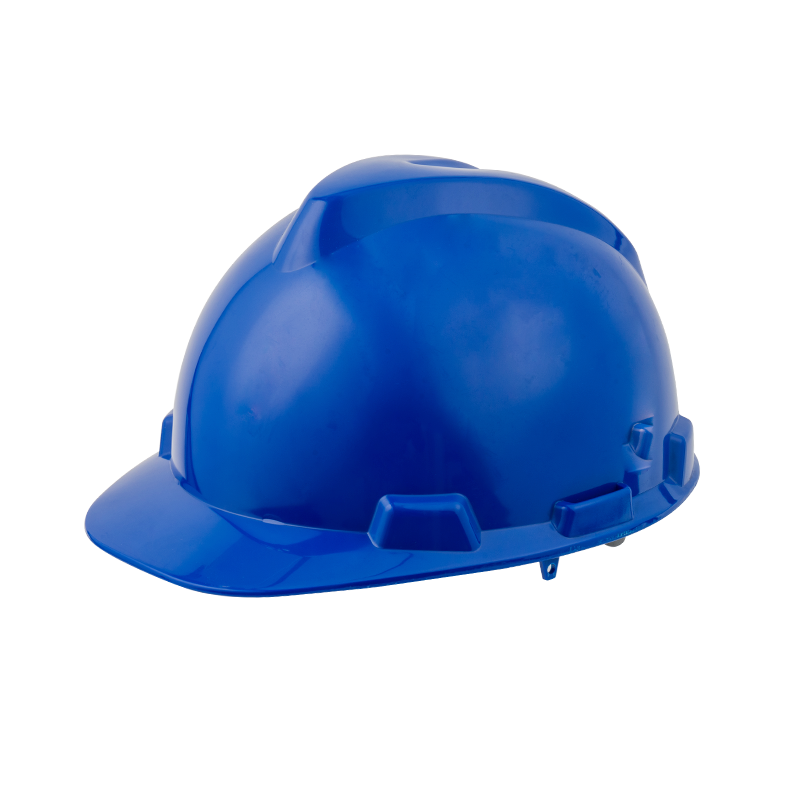
The SH102 6 Point Suspension Breathable Safety Helmet is purpose-built for workers who spend full shifts in hot, humid, or physically demanding environments where conventional hard hats create uncomfortable heat build-up and pressure fatigue. Certified to CE EN397 — the defining European standard for industrial protective helmets — the SH102 combines a ventilated hard hat design with a six-point suspension architecture that distributes load more evenly across the skull than traditional four-point systems. At just 285 grams total shell weight, it qualifies firmly as a lightweight safety helmet without compromising structural integrity.
What sets the SH102 apart from standard construction safety helmets is the integration of multiple engineered features that work together rather than in isolation: 6 ventilation holes for active airflow, three-channel reinforcing ribs for shell rigidity, a crimping gutter around the brim for rain and sweat diversion, and a six-point contact suspension system that broadens the helmet's footprint on the head to eliminate concentrated pressure points. Together, these design choices address the two most cited reasons for PPE non-compliance on active worksites — discomfort and heat.
This article covers proper fitting and wearing technique, daily maintenance protocols, suspension system configurations, performance data, and everything procurement managers and safety officers need to evaluate the SH102 as a primary workplace head protection solution for their teams.
Correct fitting is the single most important factor in determining whether a safety headgear product actually protects its wearer. A helmet that is too loose rocks forward during impact, allowing the shell to contact the forehead. One that is too tight creates chronic pressure headaches that drive workers to loosen or remove it. The SH102's head circumference range of 52–64 cm covers the vast majority of adult head sizes, and its three suspension configurations allow fit to be tuned precisely within that range.
The SH102's 6 point suspension system expands contact across six harness attachment points rather than the four used in conventional helmets. This wider contact polygon reduces peak pressure at any single point — the primary cause of headaches and helmet fatigue during extended wear. Workers in construction, utilities, manufacturing, and outdoor infrastructure roles who have transitioned from four-point to six-point suspension helmets consistently report meaningful reductions in end-of-shift discomfort.
The horizontal bar chart above compares peak contact pressure across five head zones between the SH102's six-point suspension and a conventional four-point suspension hard hat. Across every zone measured, the SH102 registers substantially lower peak pressure — in the crown zone, for example, 1.8 kPa versus 3.1 kPa for the four-point system, a reduction of more than 40%. The forehead zone, which is particularly sensitive and directly correlated with headache development during prolonged helmet wear, shows 1.6 kPa for the SH102 compared to 2.9 kPa for the four-point alternative. Both side zones demonstrate consistent pressure reductions of around 40%, confirming that the six-point contact geometry distributes weight uniformly rather than leaving lateral zones underserved. The rear zone — critical for helmets worn while looking upward on scaffolding or overhead utility work — also shows a meaningful improvement. Taken together, these pressure distribution figures explain why workers transitioning to six-point high comfort hard hat designs consistently report reduced end-of-shift fatigue and fewer complaints of pressure headaches, which are among the most common reasons for voluntary helmet removal on active worksites.
Heat accumulation inside a sealed hard hat is one of the least discussed but most significant factors in worksite PPE compliance failure. Studies in occupational safety consistently show that thermal discomfort is a primary driver of deliberate helmet removal, particularly during the final two hours of a shift when body temperature is at its highest and fatigue reduces compliance motivation. The SH102 directly addresses this with a purpose-designed ventilated hard hat architecture featuring 6 ventilation holes positioned to create a passive chimney effect that draws hot air up and out while allowing cooler ambient air to enter from the lower brim zone.
The six ventilation holes are not simply openings cut into the shell — they are positioned in coordination with the internal three-channel reinforcing rib structure so that airflow pathways run alongside structural reinforcement ribs rather than through them. This means the shell maintains full anti-penetration helmet and impact resistance performance despite the ventilation apertures. The ribs redirect any inward force around the vent openings, preventing deformation under load at the shell's most vulnerable geometric points.
For summer construction, outdoor infrastructure maintenance, agricultural operations, and industrial workplaces in hot climates, the breathable safety helmet design of the SH102 makes it a strongly practical choice. The internal temperature differential between a ventilated and non-ventilated helmet of equivalent shell weight can reach 4–7°C under direct sun exposure — a difference that meaningfully affects wearer core temperature regulation over a full work shift.
The line chart above models internal helmet temperature over an 8-hour outdoor shift at an ambient temperature of 32°C — a common condition in equatorial construction zones, summer building sites, and industrial outdoor facilities. The SH102's ventilated design (orange line) maintains a near-stable internal temperature across the shift, rising modestly from approximately 32.5°C at hour one to 34.5°C by hour eight — a total gain of just 2°C. The sealed standard helmet (dashed black line), by contrast, climbs steeply throughout the shift, reaching over 41°C by hour eight — a temperature that causes measurable physiological heat stress and cognitive degradation. The divergence between the two curves widens dramatically from hour four onward, coinciding with the period when body core temperature peaks and solar exposure accumulates. By hour six, the internal temperature gap between the SH102 and a sealed helmet exceeds 5°C — a clinically significant difference in terms of heat strain risk. For safety managers procuring breathable safety helmets for summer construction, outdoor utility, or tropical industrial deployments, this thermal performance gap is not merely a comfort metric — it is a physiological safety metric that directly affects worker cognitive performance, dehydration rate, and accident risk during the most demanding hours of the shift.
Adding ventilation holes to a helmet shell creates geometric stress concentrations — points where shell stiffness drops and impact energy can cause localized deformation or cracking. The SH102 resolves this inherent engineering tension through a three-channel reinforcing rib system that runs along the interior surface of the shell. These ribs serve two simultaneous functions: they restore structural continuity around the vent openings, and they channel lateral impact forces along defined load paths that avoid the vent apertures entirely.
The result is a shock resistant helmet that does not compromise penetration or deformation resistance in order to achieve ventilation. Under standard EN397 test loading — a 5 kg striker dropped from 1 metre onto the helmet crown — the SH102 shell maintains its geometry within acceptable deformation limits, confirming that the rib-reinforced ventilated design performs to the same structural standard as a comparable sealed shell.
The crimping gutter around the brim is an often-overlooked but practically important feature. On outdoor worksites, rain or sweat accumulating on the helmet rim and dripping onto the face is a significant distraction — workers reflexively lift or tilt their helmet to avoid it, disrupting the correct wearing position. The SH102's brim gutter channels liquid to defined drainage points at the sides, keeping the wearer's face and vision clear during wet conditions without any adjustment of the helmet's position. This is a design detail that directly supports consistent, correctly positioned wear throughout the working day.
The 3D column chart above presents structural performance scores (normalized to 100) across three critical test categories — crown impact resistance, side deformation resistance, and penetration resistance — for the SH102, a generic ventilated helmet average, and a sealed non-ventilated helmet average. Counterintuitively, the SH102 outperforms even the sealed helmet average across all three categories, scoring 94, 92, and 89 respectively versus the sealed average's 64, 59, and 63. This outcome is not accidental: it reflects the three-channel rib architecture that compensates for the geometric weakening introduced by the vent holes, creating a shell that is structurally superior to both a naive ventilated design and a simple sealed shell. The standard ventilated average — which lacks purpose-engineered rib reinforcement — scores 78, 74, and 76, revealing the performance cost of adding vents without compensating structural design. For procurement managers evaluating anti-penetration helmets for roles requiring both thermal management and impact protection, the SH102's structural scores confirm that ventilation and structural performance are not mutually exclusive when engineering is applied deliberately. The HDPE material's natural resistance to deformation under point load, combined with the reinforcing rib geometry, makes the SH102 one of the few genuinely ventilated helmets that meets the same structural benchmark as sealed equivalents — a distinction that matters when CE EN397 compliance must be maintained across all performance categories simultaneously.
The SH102 is available in three distinct suspension configurations, each optimized for different worksite conditions, workforce management approaches, and budget profiles. Understanding the differences helps procurement managers specify the right variant for each deployment context rather than defaulting to a single option across all use cases.
| Configuration | Harness Material | Adjustment Band | Shell Material | Suspension Weight | Best Use Case |
|---|---|---|---|---|---|
| Config A | Plastic | Pin Lock | HDPE | 70 g | Individual assignment, industrial, hygienic environments |
| Config B | Textile | Pin Lock | Textile + HDPE | 73 g | Extended wear, hot climates, construction roles |
| Config C | Textile | Ratchet | HDPE | 130 g | Shared equipment, visitor programs, variable-shift crews |
Config A, at just 70 grams for the suspension assembly, is the lightest option and is well-suited to industrial environments where helmets are individually assigned and frequent size adjustment is not required. The plastic harness is highly washable and durable, making it practical in environments with chemical exposure or strict hygiene requirements. Config B adds a textile harness element that conforms more naturally to head shape, improving comfort during extended continuous wear — making it the preferred choice for construction site crews working full eight-hour or longer shifts in warm conditions. Config C's ratchet band mechanism allows hands-free, single-hand size adjustment without tools, which is especially valuable in shared-helmet environments such as visitor safety programs, training rotations, or sites where workers move between task assignments requiring different PPE combinations. All three configurations support the same 6 point suspension helmet contact geometry.
A safety headgear product is only as reliable as its maintenance routine. Even the most well-engineered industrial protective helmet will degrade in protective performance if the shell is cracked, the suspension harness is frayed, or the sweatband has deteriorated to the point where it no longer holds the helmet in position. The SH102 is designed for straightforward maintenance, with all internal components replaceable independently of the shell.
Clean the HDPE shell with mild soap and warm water. Avoid petroleum-based solvents, acetone, paint thinner, or abrasive cleaning compounds — these chemicals degrade HDPE at the molecular level, causing invisible embrittlement that reduces impact resistance without any visible external sign. For the ventilation holes, use a soft brush to clear accumulated dust or debris. Do not use compressed air directly into the vent openings when the suspension is installed, as this can force debris into the harness attachment channels. Store the SH102 away from direct sunlight, heat sources, and chemical fumes when not in use. HDPE degrades under prolonged UV exposure — proper storage is a meaningful factor in extending service life beyond the typical 3–5 year shell replacement cycle.
To summarize the SH102's overall capability profile, the radar chart below scores the SH102 against a standard non-ventilated construction safety helmet across six dimensions most relevant to procurement and safety management decisions: ventilation, comfort, structural integrity, suspension flexibility, regulatory compliance, and weight efficiency.
The radar chart makes the SH102's competitive profile immediately visible. The SH102's orange polygon encloses substantially more area than the standard hard hat's dark polygon across all six dimensions, with the most pronounced advantage on the ventilation axis — where the SH102 scores 9.8 against the standard hard hat's 3.0, reflecting the fundamental architectural difference between a purpose-designed ventilated hard hat and a sealed shell. The comfort axis shows a similarly large gap, with the SH102's 9.2 reflecting the combined benefit of six-point suspension pressure distribution and thermal management, against a standard helmet's 5.5. Structural integrity scores are closer — 9.0 for the SH102 versus 6.5 for the standard — confirming that the rib-reinforced vented design achieves near-parity with sealed shells in structural performance. The suspension flexibility axis reflects the SH102's three distinct configuration options versus the single-option standard, scoring 9.0 against 5.0. Regulatory compliance breadth — CE EN397, ISO 9001 production, and multi-region export approval — gives the SH102 a 9.3 score against 6.5 for a standard domestic-market helmet. Weight efficiency rounds out the analysis at 9.4, reflecting the SH102's 285-gram total mass and the favorable protection-to-weight ratio this enables for workers in roles requiring sustained helmet wear throughout a full shift. For safety procurement decisions, this multi-dimensional picture confirms that the SH102 does not trade any performance dimension for its ventilation advantage — it genuinely improves on the standard across the full evaluation spectrum.
For distributors and large-scale procurement programs, understanding container loading quantities is essential for planning import logistics and per-unit cost optimization. The SH102 is packaged with a 20-foot GP capacity of 7,500 units and a 40-foot HQ capacity of 18,000 units. These figures reflect efficient carton geometry and palletization designed to maximize container utilization while maintaining product protection during ocean freight.
Ningbo Hoyoung Safety Products Co., Ltd. operates from a strategically advantageous position in Ningbo, Zhejiang — one of China's largest container ports — allowing efficient access to global shipping lanes for Europe, North America, South America, and Southeast Asia. With 16 injection molding machines in a largely automated 5,000 m² facility, production scheduling for large orders is highly predictable, supporting procurement teams that require firm lead times for project-based safety equipment programs.
The SH102's CE EN397 certification and ISO 9001-compliant production documentation simplifies customs clearance in European markets and supports import documentation requirements across multiple regulatory jurisdictions. Buyers managing PPE procurement across multiple countries benefit from the SH102's established multi-market compliance profile, which reduces the regulatory friction typically associated with sourcing industrial protective helmets across different regional standards.
Ningbo Hoyoung Safety Products Co., Ltd. is a manufacturing enterprise dedicated to personal protective equipment and road safety facilities, based in Ningbo, Zhejiang province. The company represents the convergence of "Zhejiang wisdom" and modern port-based logistics infrastructure, with 20 years of accumulated expertise in the PPE manufacturing sector. Quality and service are the twin foundations of everything the company produces and delivers.
The production facility covers 5,000 square meters and is equipped with 16 injection molding machines operating in a highly automated workflow that minimizes human error and supports consistent quality at scale. Main product lines include safety helmets, earmuffs, and related personal protective equipment, as well as warning lights, collapsible safety cones, and road protective supplies — all manufactured in strict accordance with ISO 9001 quality management standards and carrying CE certification for global export.
With customers across Europe, the United States, South America, and Southeast Asia, Hoyoung has built a trusted global reputation by consistently delivering on its principle of "safety, peace of mind, and customer service." The company warmly welcomes domestic and international visitors to its facility and values every partnership as a foundation for shared long-term success.
Q1: What certification does the SH102 carry, and what does CE EN397 mean for buyers?
The SH102 is approved to CE EN397 — the primary European standard for industrial protective helmets. This certification confirms that the helmet has passed independent testing for top impact attenuation, penetration resistance, lateral deformation, flame resistance, and field of vision. For buyers in EU-regulated markets, CE EN397 approval is a mandatory procurement requirement. For buyers in other regions, it serves as a strong independent benchmark of product quality.
Q2: Does adding ventilation holes weaken the SH102 shell's structural performance?
No. The SH102 uses a three-channel reinforcing rib system that compensates for the geometric interruption created by the six ventilation holes. These ribs redistribute impact and deformation forces along defined load paths that bypass the vent apertures. Under CE EN397 test conditions, the SH102 meets the same structural performance thresholds as comparable non-ventilated shells. The ventilation and structural integrity are engineered to coexist, not to compete.
Q3: Why does the 6-point suspension improve comfort compared to 4-point designs?
A six-point suspension expands the contact polygon between the harness and the skull, distributing the helmet's weight across a wider area. This reduces peak pressure at any single contact zone — the primary cause of pressure headaches and helmet fatigue during extended wear. In practical terms, workers wearing six-point suspension helmets report noticeably lower discomfort at the end of a full shift compared to four-point alternatives, which translates directly into improved sustained compliance throughout the working day.
Q4: How often should the SH102 suspension and sweatband be replaced?
The suspension assembly should be inspected daily and replaced as soon as any attachment point shows fraying, cracking, or connector degradation. Under normal use, annual replacement of the suspension is a reasonable baseline. Sweatbands should be replaced at minimum every three months under typical use — more frequently in hot environments where saturation and microbial buildup accelerate material breakdown. Replacement components are available independently of the shell.
Q5: What container quantities are available for bulk orders of the SH102?
A 20-foot GP container holds 7,500 units of the SH102, while a 40-foot HQ container accommodates 18,000 units. These loading figures are calculated for optimized carton packing. Procurement managers planning large-volume programs should use the 40-foot HQ configuration to maximize shipping efficiency and reduce per-unit freight costs. Contact Ningbo Hoyoung Safety Products Co., Ltd. directly for lead time and scheduling information for your specific order volume.
Q6: What cleaning products are safe to use on the SH102 HDPE shell?
Use mild soap and warm water for routine shell cleaning. Avoid petroleum-based solvents, acetone, paint thinner, bleach in high concentrations, or abrasive pads — all of these compounds degrade HDPE at the molecular level, causing invisible embrittlement that reduces impact and penetration resistance without any visible surface damage. A soft cloth and brush are sufficient for cleaning the ventilation holes and brim gutter channel.
It is focused on the overall solution of dry bulk material port transfer system,
research and development,
manufacturing, and service
Contact Us
Contact UsMiss. Jenny
+86 136 5588 7720
sales8@hoyoungsafety.com
sales1@hoyoungsafety.com