Content
A solar warning light improves road and work-zone safety mainly because it delivers a visible, battery-independent signal that keeps operating through power outages, remote placement, and extended overnight use, without relying on a fixed electrical connection. Warning light devices used on roads and traffic control equipment are commonly evaluated against structured criteria such as those set out in EN 12352, the European standard covering visual, structural, and operational performance requirements for electrically operated warning lights. The sections below look at how solar-powered Warning Light units function, how common configurations compare, and what factors matter when selecting a unit for road, construction, or facility safety use.
A Warning Light is an electrically operated device that signals a hazard, boundary, or work area to road users and pedestrians through a single, consistent colour and a continuous or regular intermittent flashing pattern. According to the general scope described in EN 12352, warning and safety light devices are evaluated on visual performance, such as luminous intensity and colour consistency, as well as structural durability and operational reliability under field conditions. Solar-powered warning lights extend this basic function by removing the need for a fixed power connection, which makes them practical for temporary road closures, construction perimeters, and remote hazard markers where running mains power would be impractical.
Because these units rely on daytime solar charging to power nighttime operation, battery capacity and charging efficiency are as important to overall performance as the LED output itself. A well-designed solar warning light balances panel size, battery capacity, and LED efficiency so the unit can maintain reliable flashing output through a full night cycle, including during shorter daylight periods in winter months.
Solar warning lights are produced in several configurations depending on mounting method, LED count, switch design, and panel material. The table below summarizes general characteristics of common configuration types found in road and work-zone safety equipment lines, including plug-in mounted units, single and dual LED designs, and multi-point sunflower style units.
| Configuration | Mounting Style | Typical Use |
|---|---|---|
| Plug-In Warning Light | Inserted into cone or barrier | Temporary road work zones |
| Single LED Solar Warning Light | Surface or bracket mounted | Boundary and hazard marking |
| Dual Switch Solar Warning Light | Surface or bracket mounted | Adjustable flash pattern signage |
| Multi-Point Sunflower Warning Light | Pole or post mounted | Wide-angle visibility at intersections |
The bar chart below presents an illustrative comparison of LED point count across four general warning light configuration types, using a relative count rather than a certified photometric measurement. A single LED plug-in unit generally has the lowest point count, which is suited to compact placement on a cone or barrier where a focused single-point signal is sufficient. Dual switch units roughly double the light point count, which allows for either a steadier or a more attention-drawing flash pattern depending on the selected switch mode. Multi-point sunflower style units carry the highest point count among common configurations, since their design is intended to project visibility across a wider horizontal angle at busier locations such as intersections. This kind of comparison is useful when matching a warning light configuration to the visibility angle required by a specific site.
The overall usefulness of a solar warning light depends on the combined performance of its solar panel, battery, and LED driver circuit rather than any one component alone. Polycrystalline silicon panels are commonly used in this category because they provide a practical balance of charging efficiency and manufacturing cost for compact outdoor devices. During daylight hours, the panel charges an internal battery, which then powers the LED through the night using a low-draw driver circuit designed to extend runtime. Materials used for the outer housing, such as PP (polypropylene), also affect overall durability, since a warning light is typically exposed to sun, rain, and temperature swings over its outdoor service life.
The radar chart below compares four general performance dimensions across three common solar warning light types on an illustrative 1-to-5 scale: visibility range, battery runtime, weather resistance, and ease of installation. Sunflower-style multi-point units tend to score higher on visibility range due to their wider light distribution angle. Plug-in single LED units tend to score higher on ease of installation, since they are designed to be inserted directly into an existing cone or barrier without additional mounting hardware. Dual switch units generally sit in the middle across most dimensions, offering flexible flash pattern control as a trade-off against the simplicity of a single-mode plug-in unit. Weather resistance depends heavily on housing material and sealing quality across all three types, which is why material choice, such as PP housing construction, is highlighted separately from LED configuration in most product specifications.
Because a Warning Light is only useful if it is reliably seen, visibility performance is central to how these devices are evaluated. EN 12352 addresses photometric and colorimetric performance, including luminous intensity and colour characteristics, alongside electrical safety, electromagnetic compatibility, and the continuity of the emitted light signal over time. Devices intended for export markets, including Europe, are commonly designed with this kind of structured performance requirement in mind, alongside broader quality frameworks such as ISO 9001 for manufacturing process control. Consistent flash timing and colour output across a product's operating life are particularly important for road applications, since a warning light that dims unpredictably or shifts in colour over time can reduce the margin of warning time available to approaching drivers.
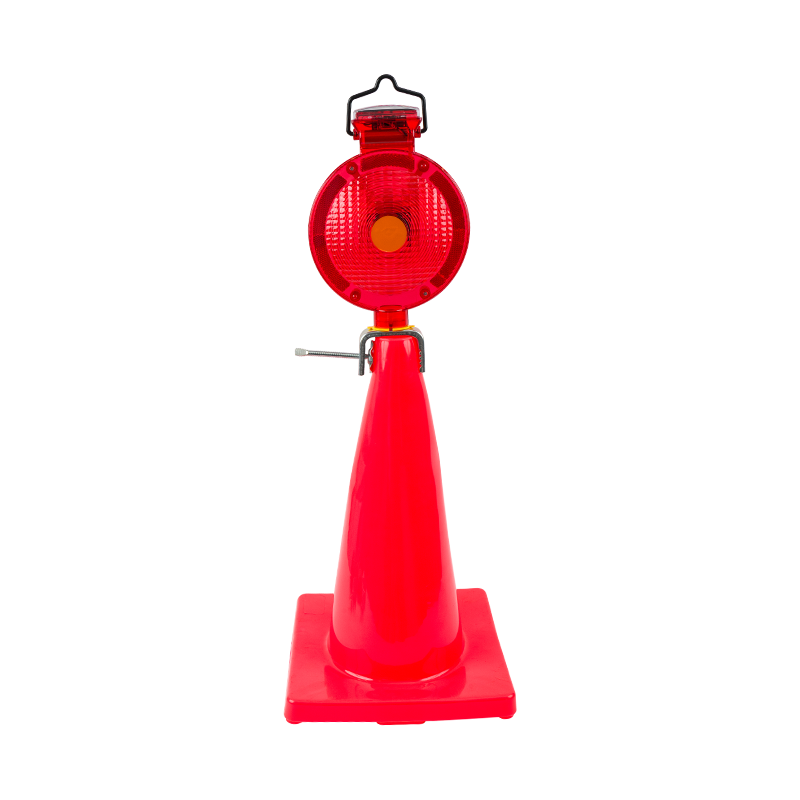
The isometric diagram below outlines the general component structure of a plug-in style solar warning light: a lens housing containing the LED and light-diffusing lens, a mounting handle for portable placement, and a tapered base designed to insert into a safety cone or similar fixture.
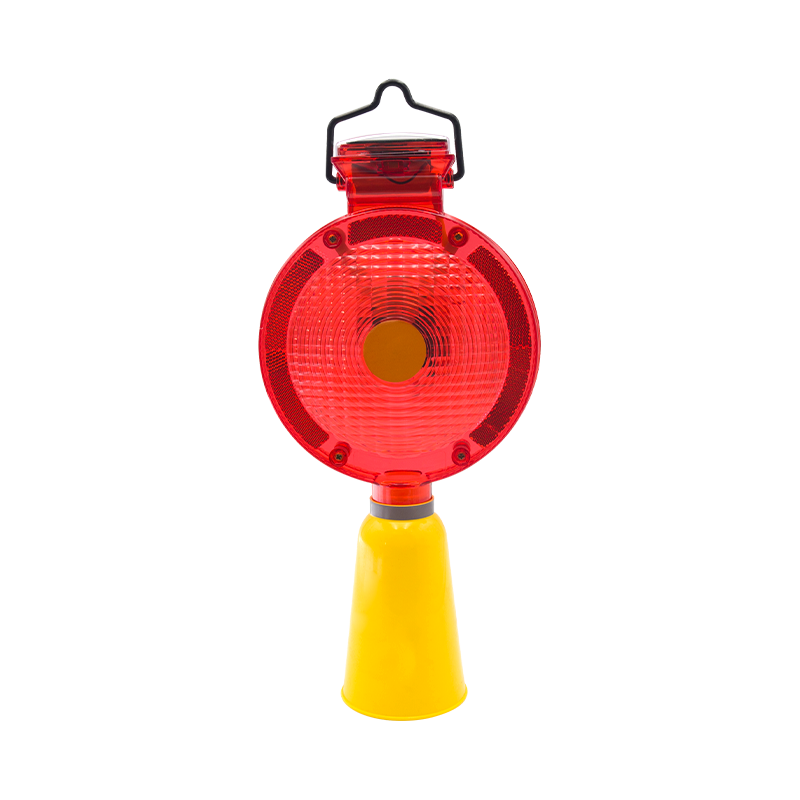
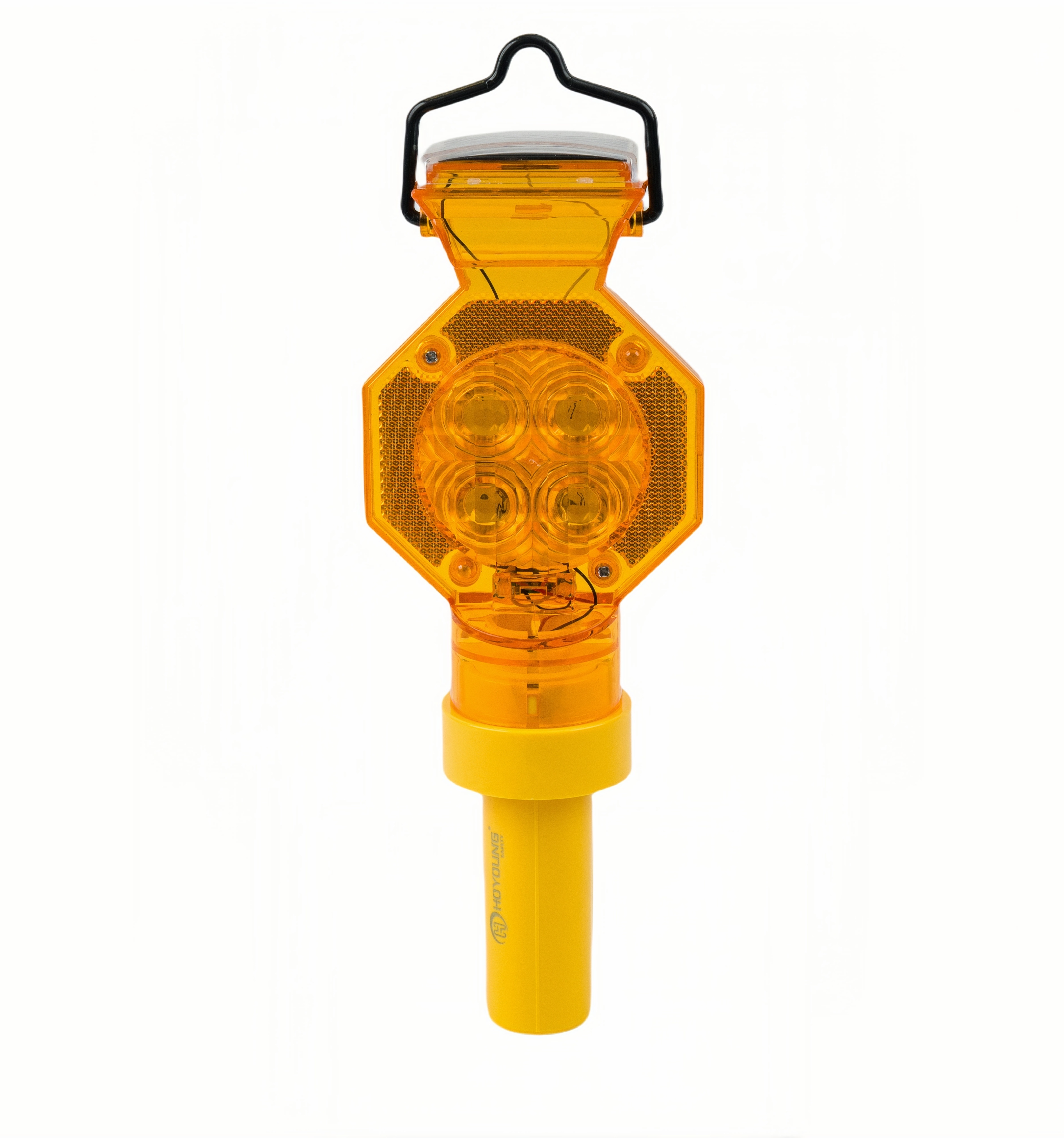
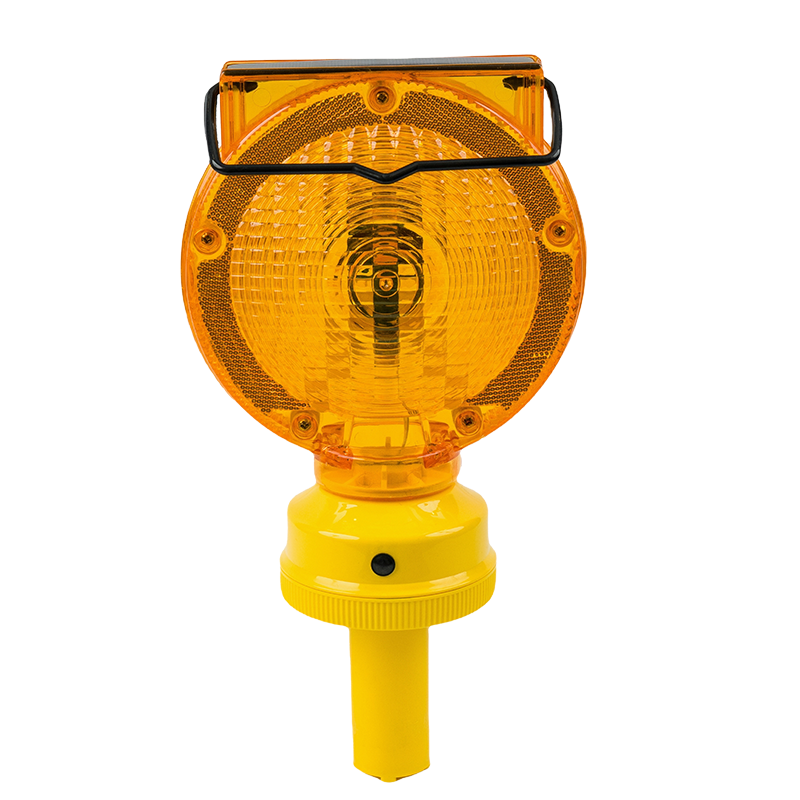
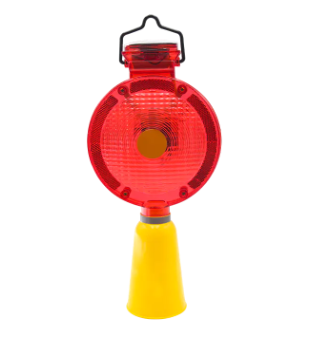
The photo below shows a representative plug-in style solar Warning Light unit, illustrating the round lens housing, central LED point, and tapered yellow base designed for insertion into a safety cone or similar road fixture.
Choosing the right warning light configuration generally depends on the mounting surface available, the required visibility angle, and the expected duration of use at a given site. The list below outlines practical factors commonly considered when selecting between plug-in, single LED, dual switch, and sunflower style solar warning lights.
Ningbo Hoyoung Safety Products Co., Ltd. is a manufacturing enterprise focused on personal protective equipment and road safety facilities and supplies, located in Ningbo, Zhejiang province, combining regional manufacturing capability with established port logistics. With the concept of quality and service first, the company has 20 years of experience in the PPE field, operating a 5,000 square meter workshop equipped with 16 injection molding machines and largely unmanned, automated production processes. Main products include safety helmets, earmuffs, and other personal protective equipment, together with warning lights, collapsible safety cones, and other road protective equipment, manufactured in accordance with the ISO 9001 quality management system. Products have passed CE certification and are exported to Europe, the United States, South America, Southeast Asia, and other regions. The company adheres to a philosophy centered on safety, reliability, and customer service, and welcomes visits from domestic and international partners interested in long-term cooperation.
Q1: How does a solar warning light stay powered overnight?
A solar warning light charges an internal battery from its panel during daylight hours, then draws on that stored charge to power the LED through the night using a low-draw driver circuit.
Q2: What is the difference between a single LED and a sunflower style warning light?
A single LED warning light emits a focused signal from one light point, while a sunflower style unit uses multiple light points arranged for wider-angle visibility at busier locations such as intersections.
Q3: What standards are commonly referenced for warning light performance?
EN 12352 is a European standard that sets out visual, structural, and operational performance requirements and test methods for electrically operated warning and safety light devices.
Q4: Can a plug-in warning light be used without a cone or barrier?
Plug-in style units are generally designed to insert into an existing cone or barrier fixture, so a separate mounting bracket or surface is typically needed if no such fixture is available.
Q5: What housing material is commonly used for outdoor warning lights?
PP (polypropylene) is a commonly used housing material for outdoor warning lights, chosen for its general durability against sun, rain, and temperature variation over extended outdoor use.
It is focused on the overall solution of dry bulk material port transfer system,
research and development,
manufacturing, and service
Contact Us
Contact UsMiss. Jenny
+86 136 5588 7720
sales8@hoyoungsafety.com
sales1@hoyoungsafety.com


 English
 Español
 عربى
عربى